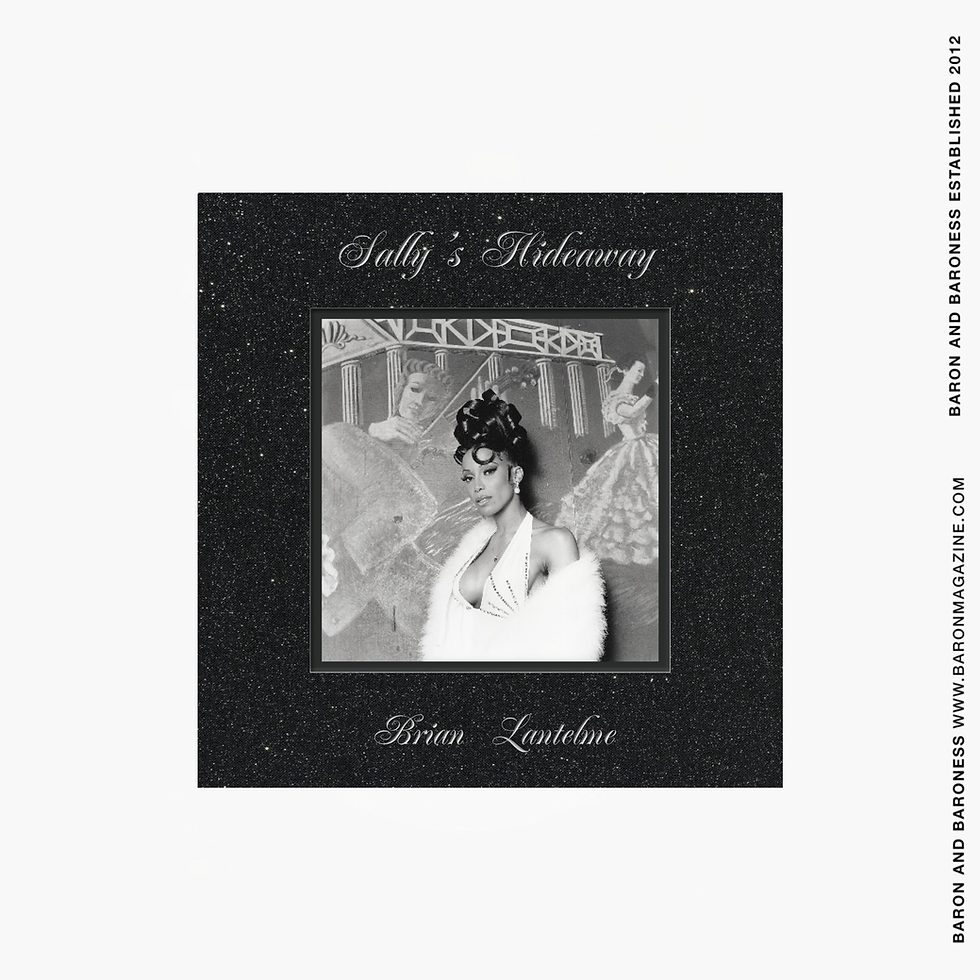
Sally's Hideaway by Brian Lantelme
Editors Notes
Baroness is pleased to present Sally’s Hideaway, a new publication by American photographer Brian Lantelme.
Sally’s Hideaway was a Times Square drag and trans bar located at 264 West 43rd Street from 1986 to 1991. The opening and closing scenes of the iconic documentary film, Paris is Burning, were shot outside the club in the late 80’s, establishing Sally’s as a cultural landmark within the trans and ballroom community.
Sally’s Hideaway was created by Sally Maggio, who had earlier managed the influential 220 Club in the 1970’s-80’s at 220 West Houston Street. The 220 was known as a central gathering place for transgender nightlife and figures like Lou Reed and is often cited as one of the most important transgender/gay nightclubs of its era. Reed’s title track and album Sally Can’t Dance (1974) is said to have been inspired by Sally Maggio.
In 1991 Sally’s Hideaway was damaged by fire and Maggio relocated the club a few doors down the block inside the Carter Hotel at 252 West 43rd Street and renamed Sally’s II. The space featured a circular bar and small lounge but behind a wall of long-closed doors, Maggio discovered the abandoned “Plantation Room,” which he transformed into an expanded performance space with a stage.
This new space became a major venue for drag pageants and ballroom events hosted by or honoring legends such as Pepper LaBeija, Octavia St. Laurent (our cover star), Avis Pendavis and Paris Dupree whose annual Paris Is Burning Ball inspired the title of the iconic film .
With emcees including Dorian Corey and Angie Xtravaganza, Sally’s thrived within a broader Times Square nightlife ecosystem that included peep shows, male burlesque houses, and drag performance venues. Performers and dancers often worked across these spaces, sustaining a vibrant and interdependent community.
Produced between 1991 and 1997, this body of work reflects Lantelme’s sustained engagement with Sally’s Hideaway and Sally’s II, forming a rare visual archive of a pivotal moment in New York’s trans and ballroom culture. He documented performers, audiences, and the atmosphere of a fleeting cultural moment. His images remain one of the most vivid records of this era.
Following Maggio’s death in 1993, the club was managed by Jessie Torres who had been with him since the 220 Club. During this period, Times Square underwent rapid redevelopment, driven in part by The Walt Disney Company, which displaced many adult businesses and transformed the district’s character. After Torres’ death in 1996, the club continued under new management but struggled to survive.
Sally’s ultimately closed in 1997 after a police raid related to a liquor license violation. Soon after, the space was taken over and its murals—once a defining visual element of the club—were destroyed. They now survive only in Lantelme’s photographs, preserving the memory of a community and cultural landscape that has since disappeared.
The book includes an essay by Miss Tiger, a visual anthropologist and curator, offering further context on the cultural and historical significance of the work.
Brian Lantelme Bio
Brian Lantelme is a photographer known for documenting New York City’s LGBTQIA+ communities, especially the BIPOC trans scene at Sally’s Hideaway and Sally’s II in Times Square during the 1980’s–90’s.
After studying film at Cornell University, Lantelme moved to NYC’s Chelsea Hotel. He worked as an assistant to the designer Halston before pursuing photography full-time, studying at institutions like NYU Tisch School of the Arts.
In the 1980’s, he became immersed in queer nightlife and ballroom culture, photographing events and forming a close friendship with Dorian Corey of Paris Is Burning. Through Corey, he joined the House of Corey and documented balls for a decade.
From 1991, Lantelme became a regular at Sally’s II, capturing its performers and community. His 1994 solo exhibition, The Times Square Show on Transsexual Identities, showcased these works. He continues to share stories from this era, honouring those he often referred to as the “gods and goddesses of Times Square.”
Hardback Book
25 x 25.5 cm
152 pages
pre-order delivery autumn/winter 2026